When “life and death are equivalent to animation and reanimation” does the divide between land and water complicate this?
.jpg)
In his analysis of Percy Bysshe Shelley’s Alastor; or The Spirit of Solitude, Morton concludes that for the Poet-speaker, ‘life and death are equivalent to animation and reanimation’. Morton’s bold terms highlight what he imagines as a fraternal interconnectedness of everything in the ‘beloved Brotherhood!’ of ‘Earth, ocean, air’. The interconnections extend to those between the Poet speaker and the earth on (and in) which he lives.
In Shelley’s brooding verse The Poet must die. It is his rotting in the earth and fertilising the ground which provides fertiliser for the whole lyrical exploit. Such a moment of death is specifically important for the Sublime vision of Shelley’s poem, where meagre human life gives way to a Nature always greater than us. From that point of bodily disintegration, the reader is witness to ‘watch the poetic writing itself’ (Morton 258).
Mary Shelley’s 1826 apocalyptic novel The Last Man uses the same rhetoric of degradation as the spark of poetical ‘reanimation’. According to its introduction, protagonist Lionel Verney necessarily experiences death and destruction in order that the frame-narrator’s creative activity can fully unfold. Verney’s story, inscribed on prophetic leaves and fallen from trees growing long ago, animates the narrator’s story-telling both because of their emotional contents: ‘soothing me in sorrow’, and because of their creative content; ‘exciting my imagination to daring flights’ .
Morton’s reanimation argument falls short in a singular aspect, but one so vital to the sentiment of Romantic elegist and catastrophic writers. It fails to distinguish between the animation and reanimation produced by nature as ‘land’, and the alternative efforts of nature as ‘water’ – specifically the ocean.
Certainly, Morton’s vision of a ‘noir ecology’ (268) incorporating a land inhabited by humans and nature stands insofar as death causes (re)animation on the ever-shifting earth.
For both Mary and Percy, the zenith of this reanimation is zeugmatically imagined in dry leaves prompting new writing and fresh creative energy. When The Poet dies, we find, ‘the charmed eddies of autumnal winds/Built o’er his mouldering bones in a pyramid’ (Alastor 52:53). Here, the death of the poet is highly active. The wind is personified, ‘charmed’ as if magical, as the line itself is metrically pacey and varied. The ‘pyramid’ built over the poet’s body by contrast is solid and constrictive – embodied by the firm spondees and geometric space of ‘a pyramid’. Therefore, the death of one thing creates a very real creation of another. For Mary Shelley, the same ‘dissolving of the difference between subject and object’ (Morton 2007 63) happens in the Cumean Sibyl’s cave.
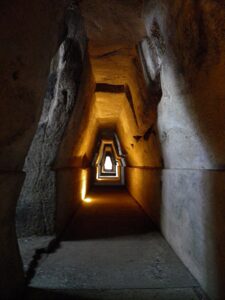
Although the story of Lionel is multiply dead – it has both not happened and simultaneously concludes in his demise – the organic scribblings on ‘leaves, bark and other substances’ produce more activity, and more story. Because they are ‘expressed in various languages’ and held deep in the ‘cavern’, the frame-narrator must undergo hours of ‘toil’ and ‘labours’, thus reanimating the creative effort which Lionel, will in the future/has already in his past, spent through the last days of the world. The dried, dead leaves for both Percy and Mary are harbingers of fresh creative energy, highlighting the active poesy over what has long since become extinct.
The earth itself acts as a creative container for reinvigorating story and poetry in both works. Mary Shelley’s novel begins inside a cave. This dank space is coded as the deepest centre of what land-nature can offer in both life and death. The cave is fundamentally formed by destructive and deadly movement of nature: ‘the whole of this land had been so convulsed by earthquake and volcano’. Yet within that, the cavern is appropriated with a familiar architectural lexicon including a ‘arched dome-like roof’ and a description as ‘the apartment’. These opposing modes see the Cumaean Sibyl’s former abode as a place characterised by both destruction and as imaginatively livable to the modern guest. Whatsmore, the cavern possesses the liminal quality of life and death at once. It is ruined, thus degenerating, but that degeneration is ‘repaired by the growth of vegetation during many hundred summers’. In exactly the same way, the Sibyl’s degenerated leaves – taken from once living, organised trees – are reanimated by the unobtrusive ‘dislocating…non-identity’ of the frame-narrator’s story spinning (Bennett 1995 147) . The leaves which were unified on the tree and scattered by time are now rearranged by the speaker, who has ‘been obliged to add links, and model the work into consistent form’. These metaphorical ‘links’ are akin to the tangible branches and roots holding a tree together in its original organic state. In a similar way, Alastor terms the volcanic caves as a place where total activity and total stillness exist. The Poet’s ‘secret caves’ (87) are literally peaceful through their ‘inaccessibil[ity]’ (89), and the dormancy required for resplendent crystals and minerals to grow. More importantly, the cave spaces are poetically peaceful, being equally inaccessible ‘to avarice or pride’ (90). The wonder which the Poet marvels at in the hidden spots of earth transcend poetic ambition and speak for themselves, animating new poetry from their mere existence rather than from excess of imagination.
So far, we have seen that nature-as-earth has the dual function to preserve and to reanimate. This is the basis of Morton’s argument, and whilst not incorrect, fails to differentiate the role that nature-as-water has on reanimation and preservation. Alastor and The Last Man, as well as works by Byron and Coleridge (consider The Rime of the Ancient Mariner, or Darkness) prove that water does not have the same preservative ability as the earth does.
Foundationally, water is antithetical to storing writing and paper. The Last Man suggests this as the Sibyl’s leaves are conspicuously sequestered in a dry chamber, and more boldly expresses water’s eviscerating quality later in the narrative. After a sea-storm, the town is damaged beyond repair. Even ‘when the tide ebbed [and] the town was left dry’, destruction dominates. The decay, which I’ve shown as vital to reanimation, is cleansed for ‘the vast ships that lay rotting in the roads were whirled from their anchorage’. The noun ‘anchorage’ is of course nautical. But if we read it in conjunction with the almost onomatopoeically rapid ‘whirled’, it becomes indicative of water uprooting the slow ecology of reanimation found on land (Morton 2007). The only thing untouched by the ocean and thus preserved is, quite symbolically, ‘the last yellow leaf on the topmost branch of the oak’. The leaf is static at this moment, waiting to slowly meld into ecological and poetical progress as it gently ‘hung without motion’.
Expanding on this, water is unable to regenerate or reanimate human life. Alastor fundamentally supposes such an idea because the creative effort literally comes from The Poet’s rotting in the earth. Shelley’s careful lines, ‘…as the human heart,/Gazing in dreams over the gloomy grave’ encapsulate this, ending with anapests that tie the heart to the grave: life to death, but both providing prosperous poetic substance. The Poet’s (re)entry into soil is necessary for the writing to exist, thus the poem predicates itself on dinginess, closeness, earthiness. The Last Man writes the unspoken antithesis to this. As Lionel, Adrian, and Clara prepare to leave Venice they look down from San Marco and turn ‘with sickening hearts to the sea, which, though it be a grave, rears no monument, discloses no ruin’. Like the classical topos which sees a watery death as the bleakest, the narrator recognises that the vacuous ocean is more suffocating and final.
The problem is that nature-as-water seems to provide a silver-bullet escape plan for Lionel and The Poet. In The Last Man, the prospect of sailing outwards continually suggests an escape from the despair of land, as well as a literal escape from ‘murky fogs’ (437) and plague-ridden populations. In an emotive apostrophe Lionel declares, ‘Ocean, we commit ourselves to thee…let us be saved’. The same goes for Shelley’s Poet, who desires the ‘little shallop floating near the shore’ (299) to move him away from the liminal space of rotting ‘putrid marshes’(274). Yet in both cases, once they embark on their boat journey into the sea, oppressive isolation and agoraphobic expanse begin to dominate. The Poet’s boat, possessed by anthropomorphic spirits, ignores its traveller’s desire to move expansively outward, instead turning to the cave. Instead of travelling out and away, it sails inwards towards a gloomy proto-grave through ‘the winding of the cavern’ (370). Equally, the starkest revelations which come upon Lionel happen in lonely moments of seafaring, where the prospect of total solitude in future and past are made starkly apparent, ‘And we alone—we three— alone—alone—sole dwellers on the sea…’.
But such an all-consuming ocean is not entirely antithetical to Morton’s concept of (re)cycles of man and poetry in his ‘noir ecology’. Rather, I suggest that understanding it requires more nuance than simply being lumped together with the general notion of earth death and decay. At first, it seems that the ocean’s movement is either completely still, or totally annihilative. Lionel’s dream in the penultimate chapter foreshadows the latter form of movement, where it pummels man and nature (here, figured as nature-as-land) indiscriminately together:
‘I awoke in a painful agony—for I fancied that ocean, breaking its bounds, carried away the fixed continent and deep rooted mountains, together with the streams I loved, the woods, and the flocks—it raged around, with that continued and dreadful roar which had accompanied the last wreck of surviving humanity. (447).
Here, the ocean is destructive violently ‘breaking’ its parameters and aggressively dislodging the continent and mountains which are expressly qualified with adjectives such as ‘fixed’ or ‘deep rooted’. This image opposes Percy Shelley’s festering, layered land of ‘mossy lawns’ and ‘slimy caverns’ whose slowness and overgrowth provide opportunity for new scenes to arise. However, Shelley never actually gives her ocean the destructive power because its moment is framed only as Lionel’s dream, and not his reality. Unlike Byron’s Darkness for instance, which sees an expansive cataclysmic end to the entire world, Shelley’s narrative only details the end of man, but never an end to nature (Stafford 1994).
The vision of a decimating ocean is fantastical – it never really transpires. Instead, the ocean’s real impacts are commented on from Lionel’s writing in Venice. Along the Grand Canal, the incoming sea is not a great ‘violator’, but instead encroaches on the aftermath of what is already defiled, as ‘the tide ebbed sullenly from out of the broken portals and violated halls of Venice’ (439). The tenderness of the verb ‘ebbed’ combined with the low-energy adverb ‘sullenly’ imbues the sea with more of the slow and grotesque energy which The Poet gives to the earth. The ocean spoils human creation through small gestures; ‘the salt ooze defaced the matchless works of art that adorned their walls’ (439), rather than a cataclysmic event. Creatively, the ocean is a philistine, damaging the artistic exploits of Venetian heritage. Viewed from Alastor’s perspective, however, the ocean is creative – not because it produces new art – but because it alters the artistic canvas. Ultimately, the narrator recognises the potential ‘in the midst of this appalling ruin’, where now, ‘nature [has] asserted her ascendancy, and shone more beauteous from the contrast’ (439). The role of nature-as-ocean is not to conduct the festering reanimation, but to whet the environment – prepare it – for slow ecosystems to grow. t is also the force which tugs at the poetic by disturbing preconceived perspectives and forcing the narrative voice to recognise that the water’s ‘source is inaccessibly profound’ (Alastor 502).
The deluge never comes in The Last Man, and the marvel of the streams are never reconciled in Alastor. Lionel remains in a quasi-maritime state which reconciles the degradation of human life amidst the regenerative power of earth and the preparative power of the ocean. For The Poet, an end of human life ‘in its last decay’ (685) is the necessary condition for this poetry to flourish – but such a conclusion can only be reached after the world’s ‘mysterious waters’ have revealed the vastness and meaninglessness of everything to him. In each case, the ocean works in conjunction with rooted trees and earthy leaves to write the story, or poem, which I read in order to write this essay.
Leave a Reply